The 5-Inch FPV Drone Build Guide: From Parts to First Arm
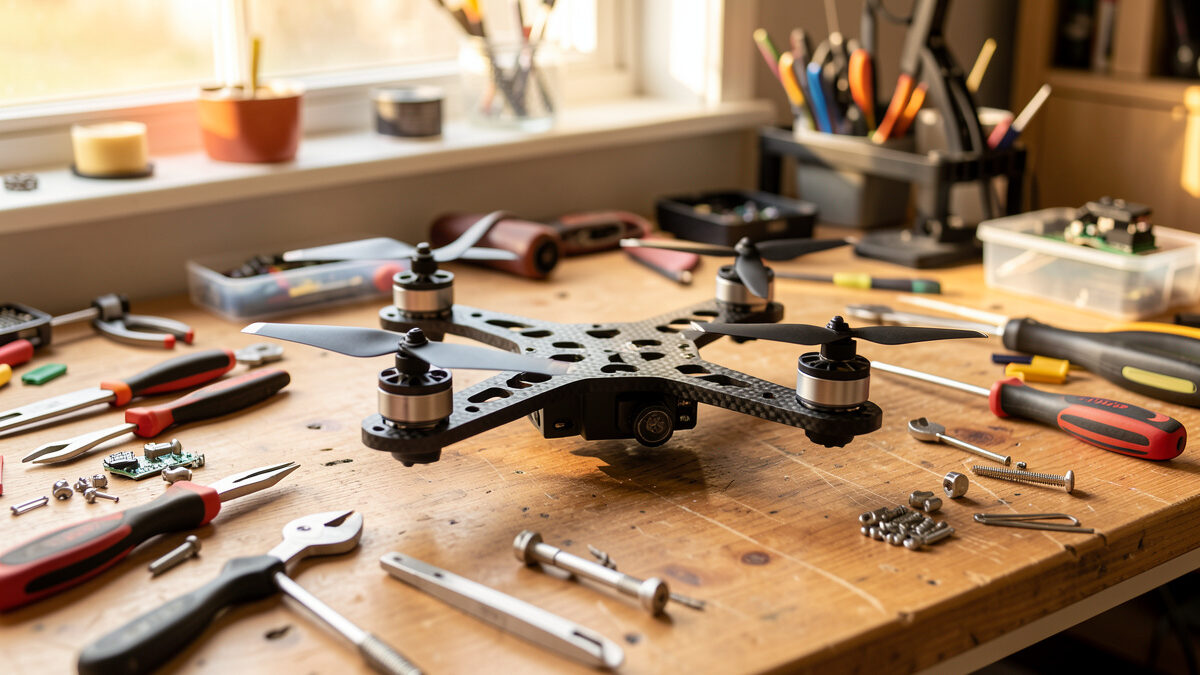
A 5-inch FPV drone build comes together from six parts that have to agree with each other: frame, motors, a flight-controller/ESC stack, a video system, a receiver, and props — and on my bench a first 5-inch freestyle quad runs roughly $250-350 in parts before goggles and a radio. Get the stack and the motors talking and the rest is soldering and patience.
I built my own 5-inch from loose parts after years of buying whoops and bind-and-fly quads, and the thing nobody tells you is that the build is the easy part — the decisions you make before you pick up the iron are what decide whether the quad flies clean or fights you. This guide is the map I wish I’d had: how the pieces fit, what each one does, and the order to make the choices in. The deep how-to for each step lives in its own guide; this is where they connect.
What Is a 5-Inch FPV Drone, and Why Build One?
A 5-inch FPV drone is a freestyle/racing quad sized around 5-inch (127mm) propellers, typically on a 220-250mm frame, powered by a 4S or 6S LiPo. It is the standard-class quad — the size that has the deepest parts ecosystem and the most tuning knowledge online, which is exactly why it is the right first self-build.
Building rather than buying a bind-and-fly does two things. It teaches you the machine — when something breaks mid-season, and it will, you already know which wire goes where. And it lets you spec for your flying instead of someone’s marketing. I went the build route because my soldering bench was already set up from years of other projects, and once you can solder a clean joint, a quad is just six components and a tidy wiring plan. If you have never flown FPV at all, build the skill before the quad: my FPV beginner entry path and the case for starting on a tinywhoop both come first. The cheapest crash insurance ever sold is simulator hours before your first armed flight — every quad I have built, I had already flown a hundred times in the sim.
Why 5-inch specifically, when there are 2.5, 3.5, 7, and 10-inch classes? Scale and support. The 5-inch is the most-built quad in the world, which means three things matter to a first-time builder: parts are cheap and everywhere, every flight controller and ESC is designed with it in mind, and when you search “my 5-inch oscillates on punch-outs” you get a thousand answers instead of silence. A 3.5-inch cinewhoop is gentler but a narrower parts ecosystem; a 7-inch long-range cruiser is a different animal with its own power and tuning demands. The 5-inch sits in the centre of the hobby’s knowledge, and that centre is the safest place to learn to build.
The Six Parts of a 5-Inch Build
Every 5-inch quad is the same six subsystems: the frame holds it together, four motors spin the props, the flight controller plus ESC stack does the thinking and the power, the VTX and camera send the picture, the receiver hears the radio, and the LiPo feeds it all. Miss the interplay between any two and you get a quad that flies hot, cuts out, or won’t arm.
The order matters because the choices cascade. Your frame decides your stack mounting size. Your battery choice (4S vs 6S) decides your motor KV and your ESC current rating. Your video system decides your antenna mounting. Below is how I think about each, and which dedicated guide goes deep on it.
Choosing the Frame: The Foundation Everyone Skips
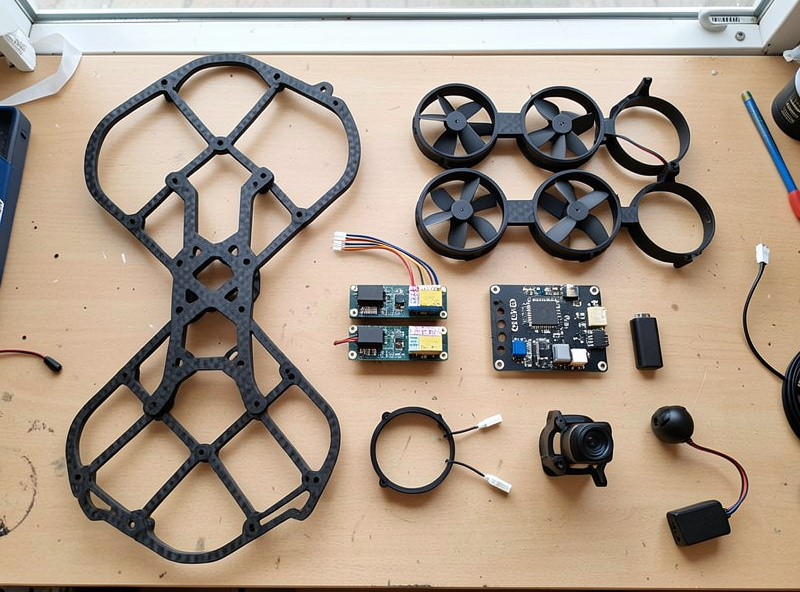
For a first 5-inch, pick a popular 5mm-arm carbon frame in the 220-225mm wheelbase range with a 20x20mm and 30.5×30.5mm stack mounting pattern — that combination fits the widest range of stacks and gets you crash parts that are actually in stock. Frame choice is where most first builders rush and then regret it.
The trap is buying an obscure or ultra-light race frame because it looked good in a video. After that crash — and there is always that crash — you want spare arms you can buy in a single click, not a six-week wait from one overseas shop. I went with a mainstream H-frame with 5mm replaceable arms for exactly that reason: thicker arms survive more, and a popular frame means the tuning community has already solved its resonance quirks for you. Check the stack mounting size before anything else, because a 30.5mm frame will not take a 20mm stack without adapters.
There is one more frame detail that bites first-timers: arm thickness and the camera mounting width. A 5mm arm is the freestyle sweet spot — 4mm arms snap more in hard crashes, 6mm arms add weight you do not need. And the camera cage on the frame is sized for either a nano (14x14mm) or micro (19x19mm) camera; analog cameras are still mostly nano-sized, while digital cameras have their own air-unit-specific mounts. Buy the camera to fit the frame, not the other way around. I keep two spare arms and a spare set of standoffs in my parts box at all times, because the single most common grounded-quad cause in my first season was a cracked arm with no replacement on the shelf.
Flight Controller and ESC: The Stack Is the Brain
The FC/ESC stack is the single most important parts decision, and it is the one beginners get wrong most often by mismatching the ESC current rating to the motors. The flight controller runs Betaflight and reads your gyro; the ESC (often a 4-in-1 board stacked beneath it) turns those commands into motor power. For a 5-inch on 6S, a 45-55A 4-in-1 ESC paired with an F7 or modern F4 flight controller is the safe, well-supported combination.
This is deep enough to deserve its own guide — see choosing your FC/ESC stack for the full breakdown of F4 vs F7, BLHeli_S vs BLHeli_32 vs AM32, current headroom, and why I run more ESC amperage than the calculator strictly demands. The short version: buy the stack and the motors as a matched set, size the ESC above your worst-case current draw, and never run a stack with no spare. A blown ESC grounds the whole quad.
| Component | Beginner-friendly 5-inch choice | What the choice decides |
|---|---|---|
| Frame | Mainstream 220-225mm, 5mm arms, dual stack mount | Crash-part availability, stack fit |
| Flight controller | F7 (or modern F4) with built-in OSD | Betaflight headroom, ease of setup |
| ESC | 45-55A 4-in-1 (6S), matched to motors | Burnout margin, smoke-stopper survival |
| Motors | 2207 1800KV (6S) / 2207 2400KV (4S) | Power band, prop pairing, current draw |
| Video | Analog 5.8GHz VTX or digital system | Goggle compatibility, antenna mount |
| Receiver | ELRS 2.4GHz | Range, radio binding, link reliability |
Motors and Props: Matching Power to Battery
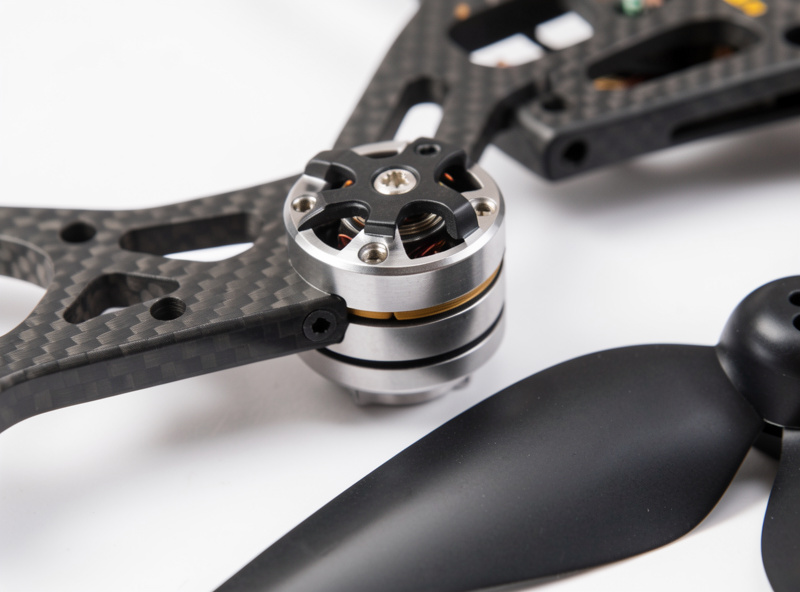
Motor KV is chosen by battery cell count, not by feel: a 5-inch on 6S typically wants 1700-1900KV motors, while the same quad on 4S wants roughly 2300-2400KV. The motor and the prop and the battery form one power system — change one and the others have to follow, or you draw too much current and cook an ESC.
For a first build I run 2207-size motors because that stator size is the freestyle standard and the prop selection for it is enormous. Pair them with a moderate tri-blade 5-inch prop to start — aggressive props amplify a bad tune and eat current. Props are consumable; buy them by the bag, because you will go through them, and inspect every one after a crash. The deeper motor/prop/C-rating math lives in its own motors-and-props guide; for the build itself, just match KV to cell count and start mild.
Here is the mistake I made that I see everyone make: I bought motors and props for the personality I wanted (fast, ripping) instead of the pilot I was (learning, crashing). High-KV motors on a heavy aggressive prop gave me a quad that was twitchy, hot, and drank a 1300mAh pack in under three minutes. Stepping down to a milder prop and learning to fly the quad I had taught me more than the power ever did. Start with motors rated for your cell count and a prop the manufacturer recommends as a “general purpose” cut, and earn the aggressive setup later once your thumbs are calibrated.
One spec to actually respect is the motor’s continuous current draw against the ESC rating and the battery’s C-rating. The chain has to hold: a 1500mAh 6S 100C pack can deliver far more burst current than four motors will pull, but a cheap 45C pack on a heavy prop can sag under load and brown out your flight controller mid-flip. When the numbers feel marginal, give yourself headroom — it is cheaper than a reflash or a new ESC.
Video System and Receiver: How You See and Steer
Your video choice has to match the goggles you own, and your receiver has to match your radio — these two are determined by gear you already have, not chosen in isolation. A 5-inch build takes either an analog 5.8GHz VTX with a clover antenna or a full digital system; the receiver today is almost universally ELRS 2.4GHz for its range and reliability.
I built my first 5-inch on analog because I already owned analog goggles and analog forgives a bad day — it degrades to static you can still fly through, where digital can hand you a black screen. The honest analog-versus-digital cost and experience breakdown is its own piece; if you are still deciding, read analog vs digital FPV for beginners before you spend. Whatever you pick, mount the VTX antenna so it survives a flip and never power a VTX without an antenna attached — you can burn it out instantly.
The receiver decision is simpler than it used to be: ELRS (ExpressLRS) on 2.4GHz has become the default for a reason. The range is enormous for the price, the link is reliable, and binding is a quick passphrase or button process rather than the proprietary-dongle hassle of older systems. Match the receiver protocol to your radio — if your transmitter runs ELRS, your receiver is ELRS, full stop. I tell every new builder to buy the radio first and let it pick the receiver, which is the whole argument behind buying the FPV controller before the drone. The receiver is a tiny board, but a bad link is the difference between a fly-away and a clean session, so do not cheap out on the antenna or the mounting.
The Build Order: From Bench to First Arm
The actual assembly follows a fixed order — solder the stack, mount it, wire the motors, add video and receiver, then configure Betaflight — and skipping ahead is how you trap a wire under a board you already mounted. The physical build is maybe two focused hours; doing it in the right sequence is what keeps it to two hours.
Two stages deserve their own deep guides because they are where it goes wrong. The first is the soldering order — which joints to make first, when to use the smoke stopper, and how to keep the iron away from the gyro. The second is first-time Betaflight setup — ports, modes, motor direction, and the checks that stop a quad flipping on takeoff. And before props ever go on a powered quad, you run the first-arm checklist. Treat those three as the spine of the build.
The reason the order is fixed is access. You solder the battery leads and capacitor to the ESC while the board is loose and you can reach every pad. You set motor wires before the stack is buried under the frame’s top plate. You bind the receiver and confirm video before you zip-tie everything down, because nothing is more demoralizing than discovering a cold solder joint after the build looks finished. I do my first power-up on a current-limited smoke-stopper every single time — it has saved at least two boards from a wiring mistake that would otherwise have gone up in a puff of magic smoke.
Plan your wire routing before you commit a joint. On my builds the battery leads exit the back, the VTX and camera wires run up the side away from the gyro, and the receiver antennas point out and down in a clear “vee” so the frame never shadows the signal. Tidy wiring is not vanity — a wire trapped under a prop or rubbing an arm is a failure waiting for the worst moment. The worst failure I ever chased on my own bench was an intermittent video cutout that only showed up after a few hard rolls: a camera wire I had routed too close to a motor lead was picking up noise under load, and it took me an evening with the goggles on the bench, wiggling the loom by hand, to find it. Now I route signal wires and motor wires on opposite sides of the stack and tack them down with a dab of hot glue, and that whole class of gremlin disappeared.
The First-Build Mistakes That Cost the Most
The expensive first-build mistakes are nearly always one of four things: an under-rated ESC, a cold solder joint, props on for a first power-up, and skipping the smoke stopper. None of them are about flying skill — they happen on the bench, before the quad has ever left the ground, and all four are avoidable.
The under-rated ESC is the classic. The current calculator says 40A, so the build uses a 40A ESC, and the first hard punch-out pulls 48A and lets the smoke out. I size ESC current well above the calculated peak for exactly this margin. The cold joint is sneakier: a joint that looks shiny but never properly wetted will work on the bench and fail under vibration in the air — which is why I tug-test every signal and power wire before closing the frame. Props-on-for-power-up is how people lose fingertips; props go on last, after every motor-direction and arming check passes. And the smoke stopper — a simple current-limiting device on the battery lead — turns a wiring short from a destroyed stack into a harmless “huh, that didn’t power up.” Buy one before your first build, not after your first mistake. If you want the field-side version of these, my write-up of expensive FPV beginner mistakes covers the flying half.
What It Actually Costs
A complete first 5-inch quad runs about $250-350 in parts (frame, stack, motors, video, receiver, props, hardware), and that is before the goggles and radio that you buy once and reuse across every quad you ever build. The all-in first-time cost including a goggle/radio entry is closer to $600-800, which is why I push the sim-first path so hard — a good FPV simulator costs the price of a few props and saves you the cost of the parts you would otherwise crash into scrap while learning.
The temptation is to chase the cheapest of every part. Don’t. The smart-money split is to spend on the stack and motors (the parts that burn out or that you fly on for years) and economize on the frame and props (the parts you replace anyway). My honest parts list breaks down exactly where the money should and shouldn’t go. And the gear you carry between quads — goggles, radio, charger, and your LiPo batteries treated with adult care — is the real long-term investment.
One last thing before the props go on: know the rules where you fly. I fly under the EU framework, where home-built FPV quads generally sit in the open category with operator registration and distance limits set out by EASA (the European Union Aviation Safety Agency) and enforced through each member state’s own aviation authority. The thresholds change, and they differ outside the EU, so I always check the current text with my national regulator rather than trusting a forum post. US readers should treat the FAA’s framework as the reference point — that is a system I do not fly under, so I will not give it as lived advice.
Frequently Asked Questions
Is building a 5-inch FPV drone hard for a beginner?
No, if you can solder a clean joint. A 5-inch build is six components and a wiring plan, taking about two focused hours. The hard part is the decisions before you build, not the assembly itself.
How much does a 5-inch FPV drone build cost?
Roughly $250-350 in parts for the quad itself (frame, FC/ESC stack, motors, video, receiver, props). Including goggles and a radio you reuse across builds, expect $600-800 all-in for a first setup.
Should I build a 5-inch quad on 4S or 6S?
6S is the modern standard for 5-inch builds — lower current for the same power means cooler-running ESCs and motors. Match motor KV to the choice: roughly 1700-1900KV for 6S, 2300-2400KV for 4S.
What is the most important part of a 5-inch build?
The FC/ESC stack. It is the brain and the power delivery, and mismatching the ESC current rating to the motors is the single most common beginner mistake. Buy the stack and motors as a matched set.
Do I need a 5-inch as my first FPV drone?
No. A 5-inch is the standard class to eventually build, but most pilots should fly a tinywhoop and log simulator hours first. The 5-inch is fast and unforgiving — earn it before you build it.
Can I fly a self-built 5-inch FPV drone legally?
It depends on your country. In the EU, FPV freestyle generally falls under open-category rules with registration and distance limits. Always read your own national aviation authority before flying — this guide is build advice, not legal advice.
Keep Building
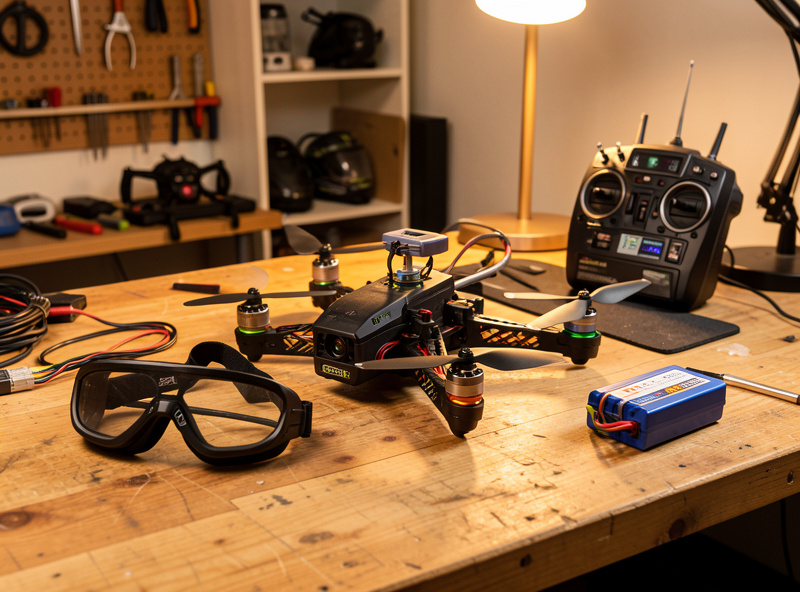
This hub maps the whole 5-inch build, and each step has its own deep guide linked above: the FC/ESC stack, the soldering order, Betaflight setup, the first-arm checklist, the honest parts list, and the bench tool kit — each goes deep where this one stays wide. Before you pick up the iron, line up the flying foundation first:
Leave a Reply