7 Expensive FPV Beginner Mistakes (and How to Avoid Them)
I’ve made most of the expensive FPV beginner mistakes myself, and I’ve watched newcomers make…
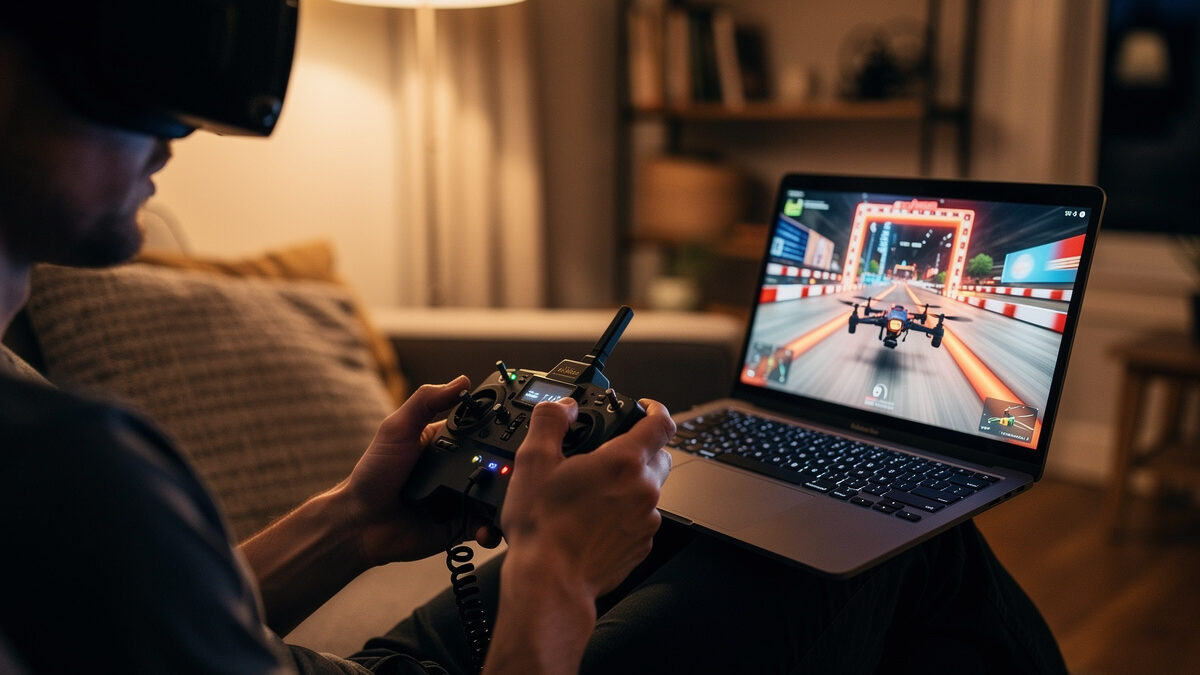
The question I get more than any other from people about to buy their first quad is some version of “how many FPV simulator hours before flying for real do I actually need?” They want a number. I understand the impulse — a number feels like a finish line. But the honest answer is more useful than a number, and it’s this: you fly the sim until the skills are automatic, not until a counter hits a magic figure. That said, I held myself to a rough target when I started, I’ve watched dozens of beginners against it, and I can tell you what the hours actually buy you — which is the only thing worth knowing.
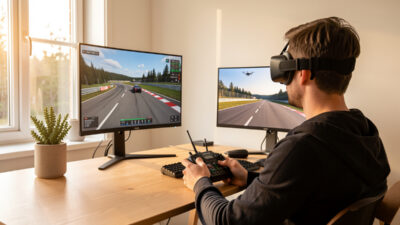
I came to FPV with a sim-rig instinct already wired in from my other benches, so the simulator wasn’t a chore for me — it was the obvious move. I logged a frankly silly number of hours before I ever armed a real quad with the props on, and every one of those hours paid for itself the first time I flew a tinywhoop and didn’t immediately bury it in a wall. Here’s everything I know about why sim time works, how much you really need, and how to spend it so it counts.
The reason simulator time works at all is that FPV flying — real acro flying, where the quad doesn’t self-level — is a pure motor skill. Your brain is learning to map stick movements to a quad’s behavior in three dimensions while your eyes are locked to a first-person view that removes every cue you normally use to stay oriented. That mapping is built through repetition, and the simulator delivers repetitions faster, cheaper, and safer than reality ever could.
The key insight is that a good sim’s flight physics are close enough to a real quad that the muscle memory transfers almost directly. When you flip a quad in the sim and recover, your hands are learning the same motion they’ll use on real hardware. The transfer isn’t perfect — real flying adds wind, real stakes, and the adrenaline that makes your hands shake the first few times — but the core stick skill carries over intact. That’s the whole game. You’re pre-loading the reflexes where mistakes are free.
So, a number, because you asked. Most beginners who put in somewhere in the region of ten to twenty focused hours in the sim arrive at their first real tinywhoop flight able to hover, turn, and recover from a flip without immediately crashing. That’s not a law of nature — some people click faster, some need more — but it’s the band I see most often, and it’s roughly where I was when the orientation stopped being a conscious effort and started being automatic.
The far more important point: those hours have to be focused. Ten hours of deliberate drilling beats forty hours of aimlessly bombing around a map. The counter is a terrible measure; what you’re actually waiting for is the moment three skills go automatic — orientation recovery, throttle management, and the disarm reflex. When those stop requiring thought, you’re ready, whether that took you eight hours or twenty-five.
Here’s how I tell beginners to spend sim time so it converts to real skill instead of just being a fun video game:
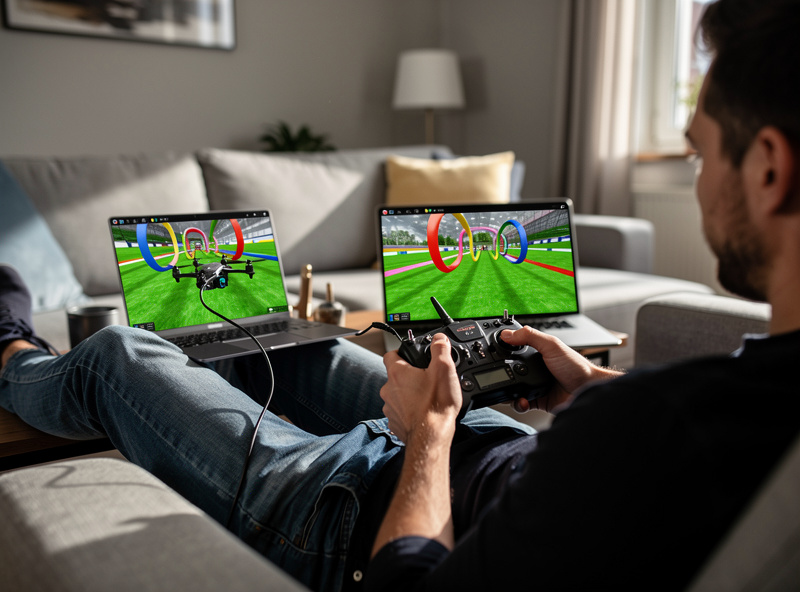
Let me put the economics plainly, because this is where the sim argument becomes undeniable. A real crash while learning costs you props, possibly a motor or an arm, time spent repairing, and — the cost nobody counts — the motivation hit of failing badly in front of people. A crash in the sim costs you a button press.
The radio you buy to fly the sim is not a throwaway, either. It’s the same transmitter you’ll bind to every quad you ever own. So the only real cost of the sim path is the simulator software itself, which runs about the price of a couple of sets of replacement props. You are quite literally buying skill at the lowest exchange rate the hobby offers. People who skip the sim to “save time” are paying for their reps in carbon fiber and discouragement instead of in cheap, safe couch hours.
If you haven’t yet chosen which sim to buy, that decision matters less than the hours but isn’t nothing — I break down the contenders in my honest look at the FPV entry path and the dedicated sim comparison linked from it. The short version: pick one with good physics, then stop shopping and start drilling.
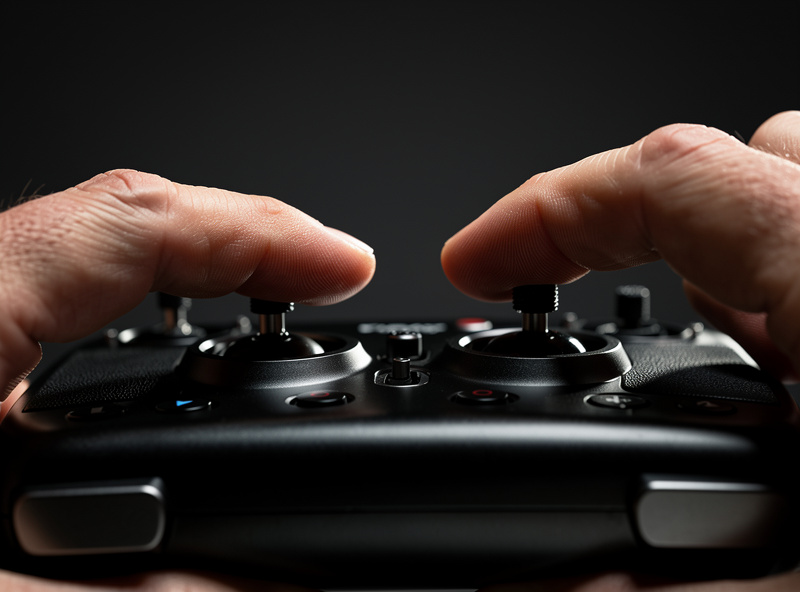
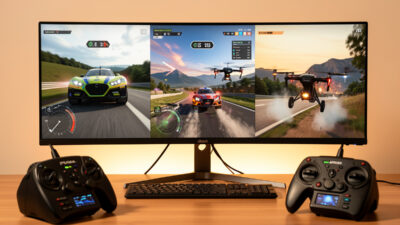
You don’t need a quad to start logging sim time. You need exactly one thing: a radio transmitter that plugs into your computer. And here’s the beautiful part — it’s the same radio you’ll keep for years, so buying it now isn’t a sim-only expense, it’s your first real FPV purchase made early. A radio with proper hall-sensor gimbals (the magnetic kind that don’t wear or drift) is what I’d point any beginner toward, because cheap potentiometer gimbals develop slop exactly as your skill starts to demand precision.
Gear I point beginners toward. As an Amazon Associate I earn from qualifying purchases. These are search links for the category, not a specific endorsement of one listing.
No — and it’s worth being honest about the gap. The sim builds your stick skill, your orientation, and your reflexes. What it can’t fully prepare you for is the adrenaline of a real first flight, the way wind shoves a light quad around, and the genuine stakes of flying near actual objects you don’t want to break. The first real flights still feel different. But the difference between a sim-trained beginner and a no-sim beginner on those first flights is night and day: one is making small corrections and recovering from wobbles, the other is in a wall within thirty seconds.
Sim hours don’t make the learning curve disappear. They move the steepest, most expensive, most discouraging part of it into a place where it costs nothing. That’s the entire value proposition, and it’s why “how many sim hours before flying” is, for me, the most important question a beginner can ask.
I’ve made most of the expensive FPV beginner mistakes myself, and I’ve watched newcomers make…
For honest physics and racing, pick Velocidrone; for the gentlest learning curve and the best…
An FPV simulator is a piece of software that lets you fly a virtual quad…
Leave a Reply